
Brooks County Parole or Probation
Parole and probation both allow a person to live outside a jail or prison while following legal conditions, but they begin in different places. Probation is a sentence or part of a sentence imposed by a court. It can start after release from Brooks County Jail, follow a period of confinement, or serve as the main community-based sentence. Parole is a conditional release from Georgia state prison authorized by the State Board of Pardons and Paroles.
The Georgia Department of Community Supervision, known as DCS, supervises adult felony probationers and parolees in the field. It does not necessarily supervise every misdemeanor probation case. A court order may identify another local or private misdemeanor probation provider. Start with the sentence, not an assumption based on the person's absence from jail.
| Point | Parole | Probation |
|---|---|---|
| How it begins | State parole-board action after an eligible prison sentence | Court sentence or order |
| First record to check | GDC offender record and parole-board information | Court docket and sentencing order |
| Field supervision | Usually DCS | DCS for adult felony cases; provider can differ for misdemeanors |
| Custody before supervision | Georgia state prison | May follow jail, prison, or no initial confinement |
| How it ends | Discharge, expiration, revocation, or other board-authorized result | Discharge, expiration, early termination, or revocation through the proper authority |
- Parole
- Conditional community release from a state-prison sentence under parole authority.
- Probation
- A court-ordered sentence served under stated conditions in the community.
- Discharge
- The formal end of a custody or supervision term.
- Absconder
- A supervised person alleged to have stopped reporting or left supervision without authorization.
Verify Brooks County Post-Release Supervision
No single Brooks County lookup resolves every supervision question. The public path follows the sentence and the agency that created the status. Use several identifiers, including the case number, date, charge, and GDC ID when available. A same-name match alone is not enough.
- Identify whether the person left Brooks County Jail, a GDC prison, or another agency. A county status of
RELEASEDdoes not say parole by itself. - Check the Brooks County court docket and sentencing order for probation, sentence length, conditions, and the named provider.
- Search the GDC offender query for a state-prison record, status, sentence, and release-related dates.
- Use the State Board of Pardons and Paroles process to interpret a tentative parole month or parole action.
- Use the DCS field-office locator to find the office responsible for a confirmed felony probation or parole case.
- For a local warrant or failure-to-appear issue, check the sheriff and court. For a supervision violation, use DCS or parole channels as appropriate.
The Brooks County released-inmate search path can establish where the custody chain began. It should then hand off to court, GDC, parole-board, and DCS records. The jail is not the source for every reporting rule, office assignment, violation, or discharge decision.
Brooks County Statewide Supervision Path
Brooks County post-release supervision is statewide rather than jail-based. The sheriff roster may show that a person left local custody, yet supervision routing depends on the court sentence, GDC status, a parole-board action, and DCS field assignment. This matters for a person who appears released online but cannot be found through a county-only supervision office.
For probation, the sentencing court is the legal starting point. A sentence can identify the term, conditions, and whether the case is felony or misdemeanor probation. For parole, begin with the state-prison record. The parole board controls the decision, and DCS handles community supervision after actual release. Calling the jail for every supervision fact can produce an incomplete answer because the sheriff does not set state parole or administer all probation terms.
Brooks County DCS Field Office
DCS publishes a statewide field-office locator. The research identified the Valdosta field-office channel as the relevant regional route for Brooks County, but office assignments can depend on residence, case transfer, and current supervision arrangements. Confirm the assigned office through the locator or DCS before relying on a location.
Georgia Department of Community SupervisionRegional routing: Valdosta field office
Valdosta office information
Statewide field-office locator
Confirm current address, phone, hours, and assignment before visiting.
The DCS Valdosta office page is the official regional source captured for Brooks County supervision routing.
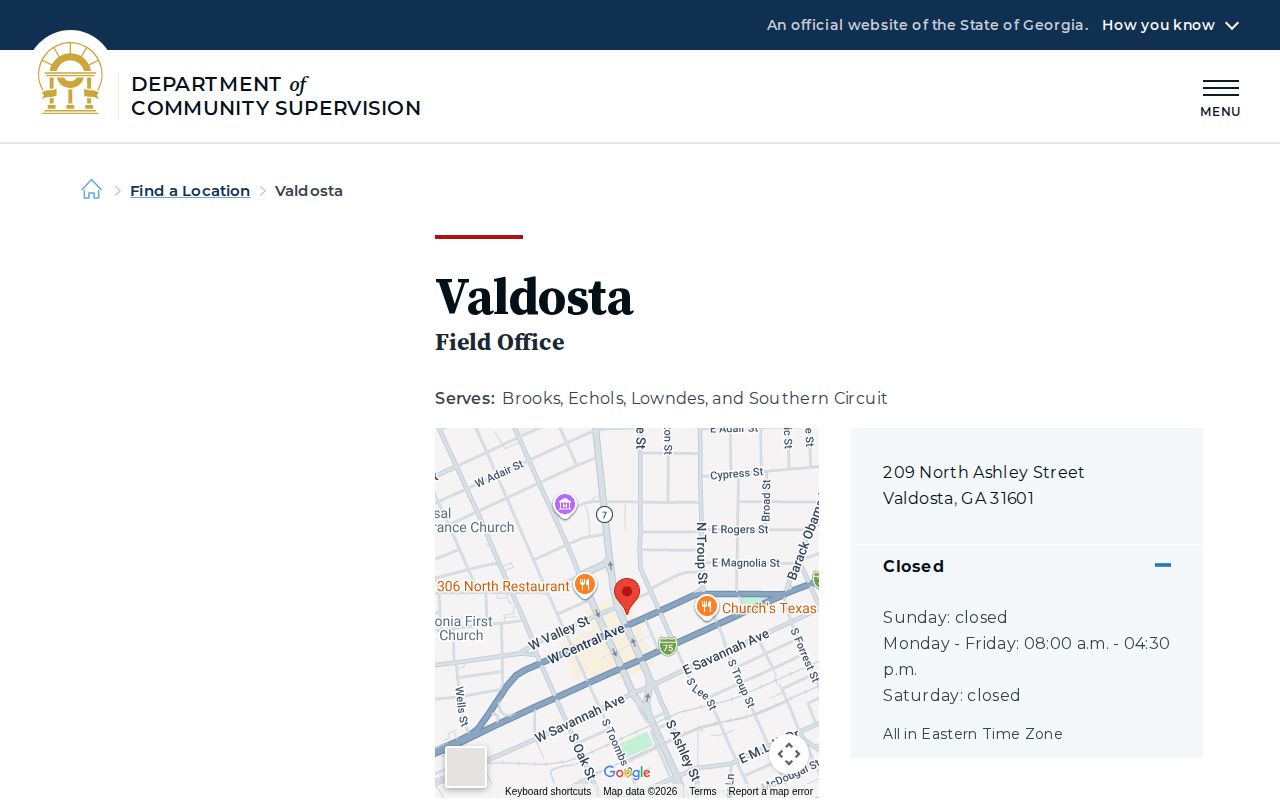
Use the office page to verify present contact details. Public staff may be able to route an office question, but some supervision details can be limited for privacy, safety, victim protection, or operations.
Brooks County Parole Decisions
The State Board of Pardons and Paroles makes parole decisions for eligible Georgia state inmates. Brooks County does not run county parole hearings for state prisoners. Individual review is often an administrative process, not a local courtroom-style hearing placed on a Brooks County court calendar. Board public meetings and process materials should not be mistaken for an individual inmate hearing schedule.
Possible outcomes include grant, denial, deferral, a tentative parole month that changes, rescission before release, revocation after release, and discharge after completion. A tentative parole month is a planning concept, not proof that the person was released. Confirm the final event through GDC status, parole-board communication, a VINELink custody change where available, and DCS supervision after release.
The captured Georgia parole-board entry point provides the authoritative statewide process context.
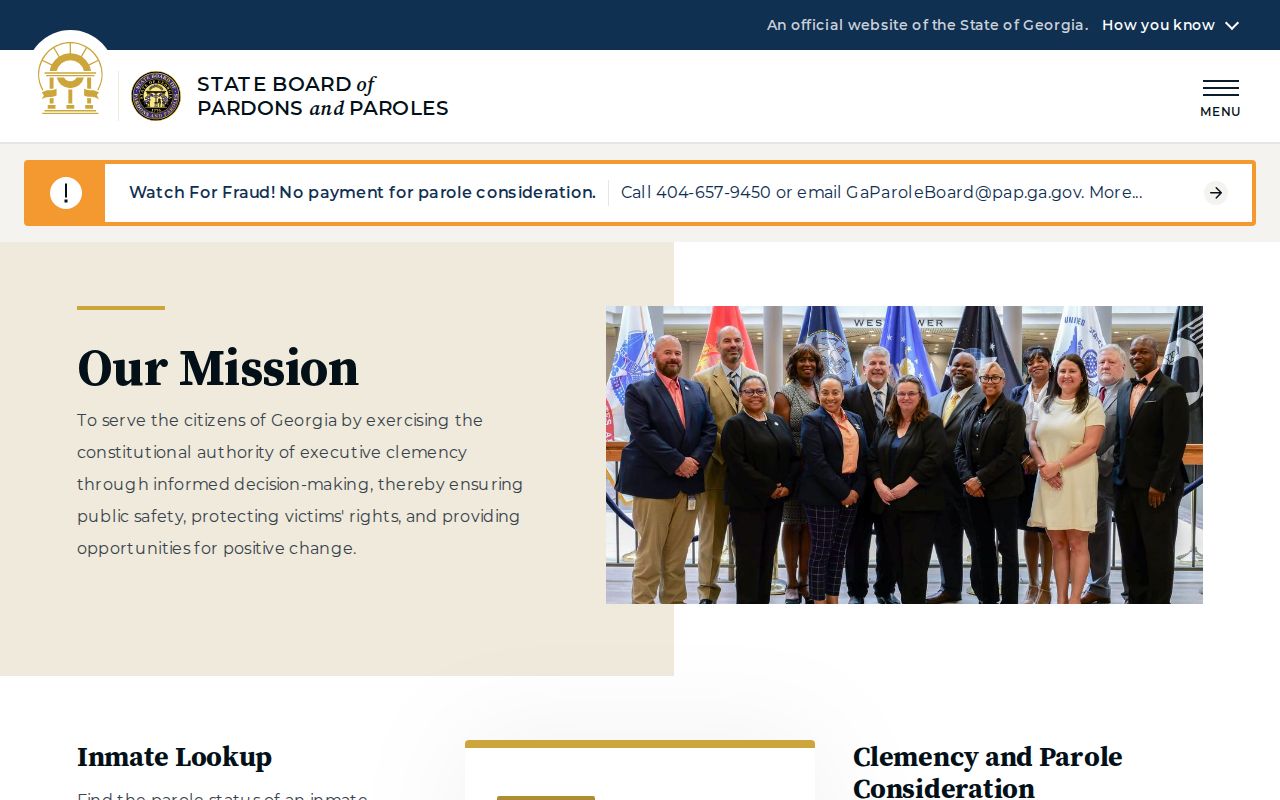
Use the board's process pages with the actual GDC record. Do not infer a grant merely because parole review is possible or a tentative month appears.
Brooks County Parole Eligibility
Georgia parole authority appears in O.C.G.A. Title 42, Chapter 9, but eligibility is not a simple fraction that applies to every sentence. The offense of conviction, sentence, prior-record provisions, mandatory minimums, board rules, and other offense-specific statutes can alter the result. Serious violent felonies under O.C.G.A. § 17-10-6.1 carry special sentence-service and parole consequences.
Life sentences, recidivist provisions, sex offenses, and other categories may also require special analysis. The reliable path is to read the sentencing order, identify the precise offense and statute, review the current GDC record, and consult official board information. Good-conduct or earned-time concepts do not turn a tentative date into a promise. Credits may not apply in every case and can change under law, policy, discipline, or later court action.
Brooks County Supervision Violations
Supervision conditions vary by sentence and case. They can include reporting, travel limits, treatment, payment obligations, testing, or other court or board terms. Public records may reveal the existence and length of supervision without exposing the complete supervision file. The controlling order and assigned agency are the sources for an individual condition.
A violation allegation does not mean the person is already in jail. DCS or parole authorities may investigate, seek a warrant, change supervision, or begin a revocation process. “Absconder” generally refers to someone alleged to have stopped reporting or left supervision without permission. A public absconder notice, when one exists, should be matched to the correct identity and agency.
Use the Brooks County sheriff or court for local warrants and failure-to-appear entries. Use DCS and parole-board channels for state supervision violations. VINELink is a custody-notification layer, not a full supervision docket. It may report a new custody event from a participating agency, but it does not replace the violation or revocation record.
Brooks County Supervision Notifications
VINELink can help with a custody change when a participating agency sends the record. Select Georgia, search by name or identifier, compare the agency and personal details, and register for a notice if offered. Phone, email, or text choices and a PIN or confirmation step may be available. Register before an expected release because a past record may later disappear from active display.
A VINELink status such as released, transferred, out of custody, or no longer in custody may help mark a transition. It does not establish every parole or probation condition. The sheriff's release sheet provides local release facts, GDC provides state-prison status, the parole board supplies parole-decision context, the court supplies probation orders, and DCS handles field supervision.
Brooks County Supervision Discharge
Supervision can end through expiration, formal discharge, early termination where authorized, completion, revocation, or another court or board action. A person who is no longer reporting should not automatically be described as discharged. The public confirmation depends on the kind of supervision.
For probation, look for a discharge order, docket entry, or confirmation from the proper supervising authority. For parole, use the board, GDC, and DCS record path. A revocation can return a person to custody, while a warrant can leave the person out of custody but subject to arrest. These are distinct statuses. Ask for the order or official status that ended the term.
Georgia's Open Records Act may support access to nonexempt public records, but agencies can redact confidential supervision, medical, victim, security, or investigative details. Request the specific public fact needed, such as supervision type, start or end date, discharge order, or public warrant status. Narrow requests are easier to route and less likely to involve unrelated protected material.
Record the office, case number, order date, and exact status language used by the source. “Inactive,” “closed,” and “discharged” may not mean the same thing across a court docket, GDC profile, board record, and field-supervision system. When sources differ, the authority that issued the sentence or parole action should clarify the controlling status. A final discharge also differs from merely reaching an expected end date, since later orders, tolling, violations, or revocation proceedings can affect the public record.