
Georgia DOC Release Records
The Georgia Department of Corrections offender query is the main public source for a Brooks County defendant who entered state-prison custody. It asks a different question from the sheriff roster. The county roster records local bookings. GDC shows whether a person entered Georgia corrections, where the state record places them, and which sentence or release fields are public.
A former state prisoner can remain searchable after release. The detail may include name, GDC identification number, photo, current status, facility or prior location, offenses, sentence history, maximum or tentative dates, an actual release date when present, and clues about parole or probation. Field availability varies. Match several identifiers because names repeat and a photo alone is not enough.
The search result should be read as a state corrections record, not a complete account of the criminal case. It may combine more than one sentence or offense. Review each sentence line and county reference before connecting a date to the Brooks County matter. A status that suggests release may coexist with a supervision clue because confinement and community supervision are separate stages. When an entry appears inconsistent, compare it with the sentencing order and ask the agency that owns the disputed field.
| GDC field | Release meaning |
|---|---|
| Status | Starting point for custody, release, or supervision context |
| Location | Current or prior state assignment, not a county booking location |
| Tentative or maximum date | Planning date or sentence limit, subject to change |
| Actual release date | Recorded state release event when present |
| Sentence and offense | Context for eligibility, credits, and statutory limits |
Confirm a Georgia DOC Release
Search by full name and add a middle initial, age clue, or GDC ID when known. Open the detail only after comparing the result with the Brooks County conviction, date of birth, sentence, offense, and photograph where available. Read status and location before reading dates. A future date does not mean the person is already out, and a county-jail release status does not establish discharge from GDC.
- Enter the person's name or GDC ID in the official query.
- Match birth information, offense, conviction county, sentence facts, and photo.
- Review status and location to decide whether state custody is active.
- Compare tentative, maximum, and actual release fields.
- Check the Brooks County sentence and parole or DCS channels for context.
- Ask GDC records or the sentencing court to clarify an ambiguous field.
An empty search is not final proof that GDC never held the person. A misspelled surname, name change, compound last name, delayed intake, or mismatched identifier can hide the record. Try the exact legal name from the Brooks County judgment, then search again with fewer fields. If the person was only booked locally and released on bond, however, the lack of a GDC result is expected. Return to the sheriff and court channels for that event.
Georgia DOC Records Channels
The public query is fastest, but it does not expose every sentence-computation record. Use the Georgia Department of Corrections public site for records routing. Give the full name, GDC ID, birth date, sentencing county, offense, and approximate admission or release period when known. Ask for state status, sentence history, release or discharge information, and clarification of a disputed public field.
Georgia Department of CorrectionsStatewide corrections and offender-record authority
Use the official GDC site for current records-office routing and hours.
The Brooks County court holds the judgment, sentence, jail-credit rulings, and amendments. The sheriff holds local booking and transfer facts. Georgia open-records rules may permit search and copying charges. No specific GDC fee or counter schedule was supplied in the research, so request a cost estimate and current submission directions before ordering copies.
Ask for a defined record rather than a broad narrative investigation. Useful terms include offender profile, sentence computation, release record, discharge status, and custody-location history. State the date range and identify the Brooks County sentence. Some information can be withheld or redacted under public-record limits, but a narrow request makes it easier to separate public fields from protected material. Keep the response with the court order when dates are important because later corrections can change the public display.
Brooks County State Transfers
GDC is a statewide system, not a second Brooks County jail roster. A defendant becomes a GDC search subject after a state sentence or transfer into state corrections. Intake and public posting can take time. A person who bonds out, finishes a misdemeanor county sentence, or has a local charge dismissed may never receive a GDC record for that event.
When a sheriff booking says released, inspect the destination. “Released to GDC” or similar transfer language means state custody began or resumed. Search GDC after intake, then compare the entry with the Brooks County judgment. If no result appears, check spelling, allow for processing, and verify transfer with the sheriff or court instead of assuming community release.
The reverse path also matters. A GDC release to parole means the person left state prison, not that the underlying conviction vanished. A return to Brooks County may depend on an approved residence or supervision plan, and the public offender detail may not publish each practical release arrangement. DCS handles felony parole and probation supervision in the field. The parole board controls the parole decision, while GDC records the prison status and release event.
Georgia DOC Release Dates
A maximum date, projected date, tentative date, tentative parole month, and actual release date are different fields. A maximum date relates to the sentence endpoint reflected by the record. A projected or tentative date is an administrative estimate. The parole board's tentative month is a separate planning concept. Actual release indicates a state release event when present.
Dates can move because of sentence corrections, jail-credit changes, earned or performance credits, discipline, new sentences, detainers, and parole decisions. Credits are not universal. They can be limited, withheld, lost, or recalculated. Use Release Date Lookup for the county-versus-state calculation path.
Do not compute a personal release date by subtracting a standard percentage from the sentence. Georgia's rules vary by offense and legal category. The sentence start, credited jail time, consecutive or concurrent structure, statutory minimum, parole eligibility, and later court orders can all matter. GDC sentence administration and the parole board perform different parts of the process. The current agency record is more useful than an outside estimate, and only an actual release status confirms that the event occurred.
The official GDC offender search shown below is the matching statewide source.
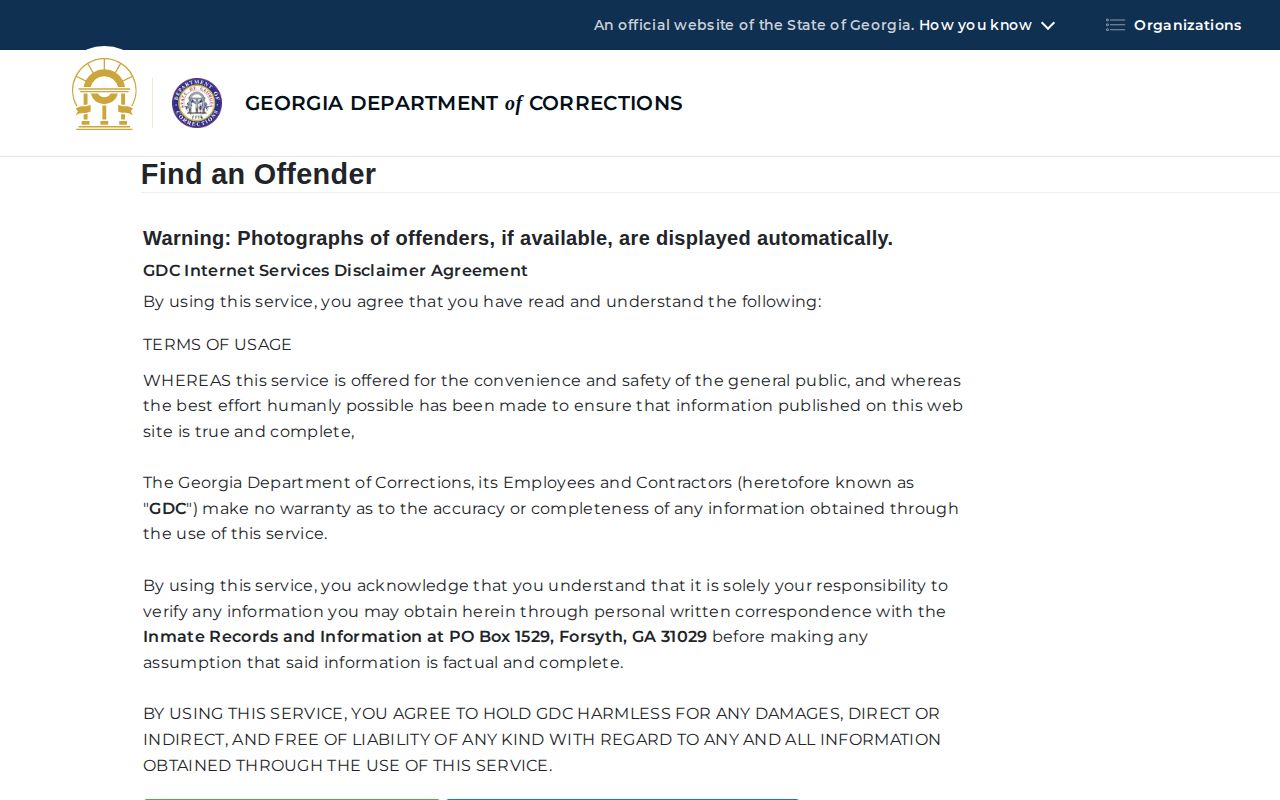
Confirm identity, status, and sentence context before interpreting any release-related date.
Georgia Parole Release Status
The State Board of Pardons and Paroles process adds a decision layer for eligible inmates. The board may set or change a tentative parole month, then grant, deny, defer, or rescind action. Georgia parole authority comes from Title 42, Chapter 9, with offense-specific limits elsewhere.
O.C.G.A. § 17-10-6.1 treats serious violent felonies differently, which makes a simple percentage estimate unsafe. Eligibility depends on offense, sentence, mandatory provisions, prior-record rules, and board policy. Confirm release through GDC status. After parole release, use Post-Release Supervision and DCS for field-office routing.
A board outcome can be granted, denied, deferred, changed, rescinded before release, or revoked after release. A tentative month merely signals a planned review or release point under the board process. It does not show that every prerequisite has been met. Compare board information with the latest GDC status, then use DCS only after the record indicates community supervision. Brooks County does not operate its own state parole hearing calendar.
After a Georgia DOC Release
Physical release does not always end the sentence relationship. A person may leave prison on parole and report through the Georgia Department of Community Supervision. Another may complete confinement yet remain on probation from the sentencing court. A later discharge ends the identified custody or supervision status, but its exact effect depends on the record and order.
- Projected date
- A changeable estimate from sentence administration.
- Tentative parole month
- A board planning point, not guaranteed release.
- Parole
- Conditional community release from state prison.
- Discharge
- Completion or termination of the identified status.
Use Brooks County court records for the conviction and sentence, GDC for state custody and release facts, the parole board for parole decisions, and DCS for field supervision. VINE Inmate Check may supply an alert, but it does not replace the official state record.