
Brooks County Supervision Paths
Release from custody and placement under supervision are separate events. A Brooks County defendant can leave jail on bond with no supervision, receive probation in a court sentence, transfer to state prison and later leave on parole, or finish a term with no active community supervision. The release record answers when custody ended. The court, parole board, GDC, and Georgia Department of Community Supervision explain the legal status afterward.
DCS supervises adult felony probationers and parolees in the field. It is not the jail operator, sentencing court, or parole-decision board. Brooks County supervision may be routed through a regional field office serving the Southern Judicial Circuit or South Georgia rather than an office inside the county jail. The correct office depends on the supervision type and assigned reporting location.
| Post-release status | Primary record or agency |
|---|---|
| Felony probation | Court sentencing order, then DCS field supervision |
| State parole | GDC release, parole-board action, then DCS |
| Misdemeanor probation | Local court and named probation provider |
| Bond release | Sheriff release sheet and pending court docket |
| No active supervision | Sentence, discharge, or completion record |
Verify Brooks County Supervision
Start with the order that created the status. A court sentence identifies probation, its length, conditions, and whether the matter is a felony. A GDC record shows state-prison custody and release clues. The parole board supplies the parole decision. DCS then routes active felony probation or parole in the community, subject to limits on public information.
- Identify whether release came from Brooks County Jail, GDC, or another agency.
- Read the court docket and sentence for probation terms and case status.
- Search GDC when the person served a Georgia state-prison sentence.
- Use parole-board records for a state parole decision or tentative month.
- Open the DCS field-office locator for supervision routing.
- Use sheriff and court warrant channels for local warrants or failures to appear.
Match the person's full name, date of birth when lawfully shown, case number, offense, sentencing county, and GDC ID where relevant. Do not infer active supervision from an old sentence alone. A later discharge order, completed term, revocation, transfer of supervision, or new case can change the current status. The responsible office should resolve conflicts between public sources.
Brooks County DCS Routing
Use the official DCS office locator to find the current office serving the person's assigned area. The research identifies the Valdosta field-office page as a practical South Georgia routing source for Brooks County. Office assignments can change, so confirm the correct reporting office through DCS rather than treating the jail address as a supervision contact.
Georgia Department of Community SupervisionStatewide felony probation and parole field agency
Use the DCS locator for the current Brooks County service office, phone, and hours.
When asking for routing, provide the person's legal name, date of birth if appropriate, Brooks County case number, supervision type, and assigned residence area. Public-information limits may prevent release of schedules, private addresses, treatment facts, or safety-sensitive details. A narrow request for the responsible field office or public status is more suitable than asking for a complete supervision file.
DCS is not the records custodian for the county-jail release sheet or the court's judgment. Direct jail time and release questions to the Brooks County Sheriff's Office. Direct sentencing, probation-order, and completion-order requests to the relevant court clerk. Direct state-prison status to GDC and parole decisions to the State Board of Pardons and Paroles.
Office routing should follow the assigned supervision location, which may not be the county of conviction. A Brooks County case can be supervised from another area after an approved move, while a person convicted elsewhere may reside under supervision in South Georgia. Confirm both the case source and current field-office assignment. If DCS cannot disclose a personal status, the public court sentence and GDC or parole record can still establish the legal path without exposing private reporting details.
Brooks County Probation Records
For probation after a Brooks County jail release, the court record comes first. The sentence should identify the confinement term, time served, probation length, special conditions, and whether supervision is felony or misdemeanor. The roster can show that jail custody ended, but it cannot prove the terms of probation. A bond release also should not be mislabeled as probation unless the court entered such an order.
DCS generally supervises adult felony probation. It may not supervise every local misdemeanor case, private-provider arrangement, municipal matter, or pretrial release. Read the order for the named agency. A probation discharge order may later show successful completion. Revocation filings can show an alleged violation and a court response, while the current DCS office handles field reporting for active state supervision.
Probation means court-ordered community supervision that may replace or follow confinement. It differs from parole, which conditionally releases a person from a state-prison sentence. Both may involve DCS in the field, but their legal source is different. That difference controls which record proves the status and which agency can correct it.
Brooks County Parole Supervision
A Brooks County conviction can lead to state prison and later parole, but Brooks County does not make the state parole decision. Start with the GDC offender search to confirm the state sentence, identity, and release-related status. Then use the Georgia parole process to interpret board action. DCS becomes the field agency after an actual parole release.
A tentative parole month is not proof of release. The board can grant, deny, defer, change, or rescind an outcome, and a detainer or other legal event may affect the custody path. Confirm physical release through GDC status and an actual release field when available. Then ask DCS for the correct supervision-office route, subject to what the agency may disclose.
The official DCS public site shown below is the matching community-supervision source.
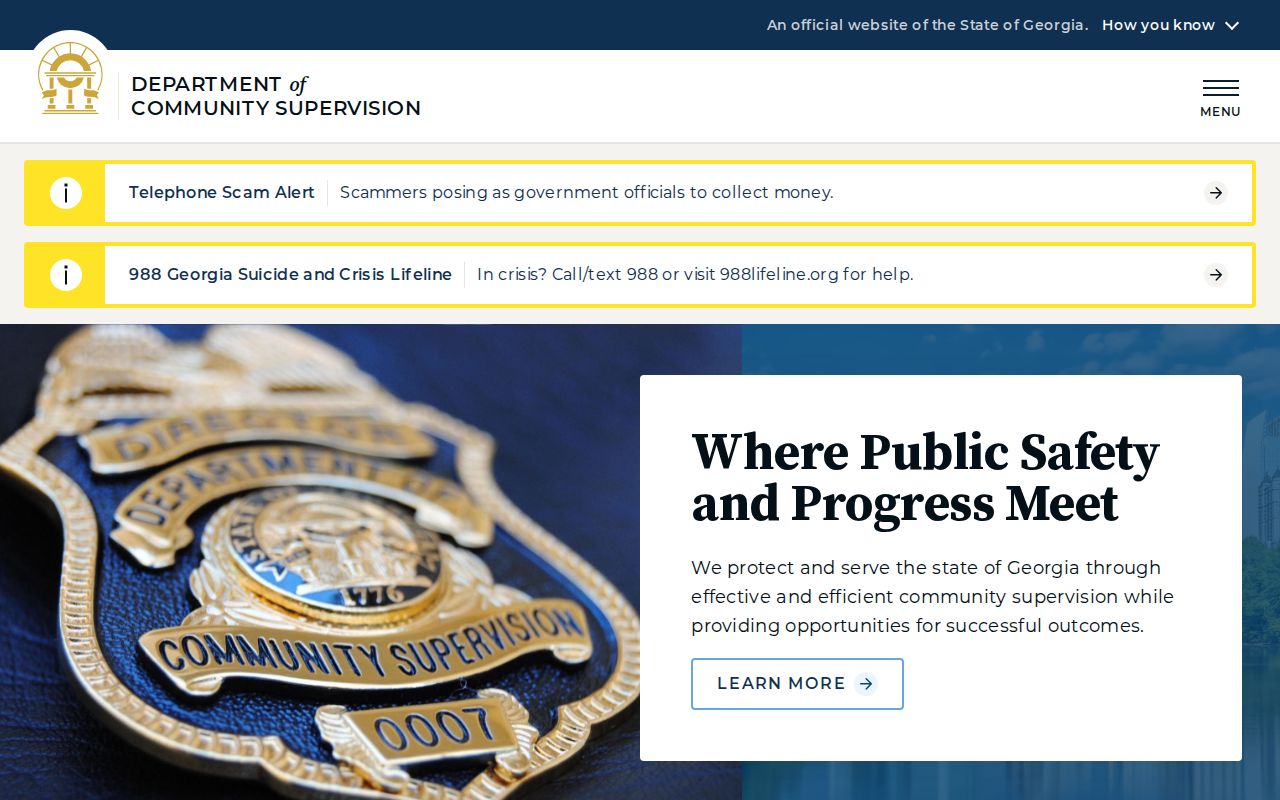
The statewide DCS entry point separates field supervision from the sheriff, court, GDC, and parole-board roles.
Brooks County Parole Review
Georgia parole consideration is an administrative state process, not a Brooks County courtroom hearing for each inmate. The State Board of Pardons and Paroles publishes process, meeting, and public information. Individual review timing follows eligibility and board procedures rather than a county hearing calendar. Do not expect the Brooks County court docket to list a local parole hearing.
Georgia parole authority is found in O.C.G.A. Title 42, Chapter 9. Eligibility also depends on the offense, sentence, mandatory minimums, prior-record provisions, and statutes such as O.C.G.A. § 17-10-6.1 for serious violent felonies. A simple rule that everyone qualifies after the same fraction of a sentence is inaccurate.
Public outcome clues may come through GDC status, parole-board communication, and DCS supervision after release. Possible outcomes include grant, denial, deferral, a tentative month set or changed, rescission before release, revocation after release, and discharge after completion. The latest official records should be compared because each source documents a different stage.
Board meeting materials should not be confused with a personal case calendar. Public board meetings follow the board's schedule, while an individual inmate's review proceeds under administrative timelines. For a named person, the safer sequence is the GDC offender detail, any direct board communication that is public or available to an authorized recipient, and DCS routing only after release. Brooks County court records remain useful for the original offense and sentence category.
Brooks County Violation Records
A person can remain released yet later face an alleged supervision violation. An absconder is someone alleged to have stopped reporting or left supervision without authorization. That label does not itself mean the person is currently jailed. A warrant, revocation petition, hearing result, and new booking are separate records that may appear at different times.
- Absconder
- A supervision status tied to alleged failure to remain in contact or comply.
- Revocation
- A legal process that may change or cancel community supervision.
- Warrant
- A court or agency command authorizing arrest under stated authority.
- Discharge
- Completion or termination of the identified supervision term.
Check the sheriff and Brooks County court for local warrants, failures to appear, and revocation filings. Use DCS or parole channels for the supervision side. If a new arrest occurs, the current jail roster may show custody, but the prior DCS record explains why supervision was active. Do not treat a missing name on the jail roster as proof that no warrant or violation exists.
This statewide route is the distinctive Brooks County supervision pattern identified in the research. The jail can confirm its release record, but continuing probation or parole must be traced through the court sentence, GDC status, parole-board action, and DCS field office. Post-Release Supervision provides the broader comparison, while this system page focuses on DCS routing.